
Diamond Education
Natural & Laboratory-Grown Diamonds
Different origins. One informed choice.
Both are real diamonds. They share the same crystal structure and optical properties; what differs is where and how they formed. Nicotalya offers both, held to one House standard of beauty.
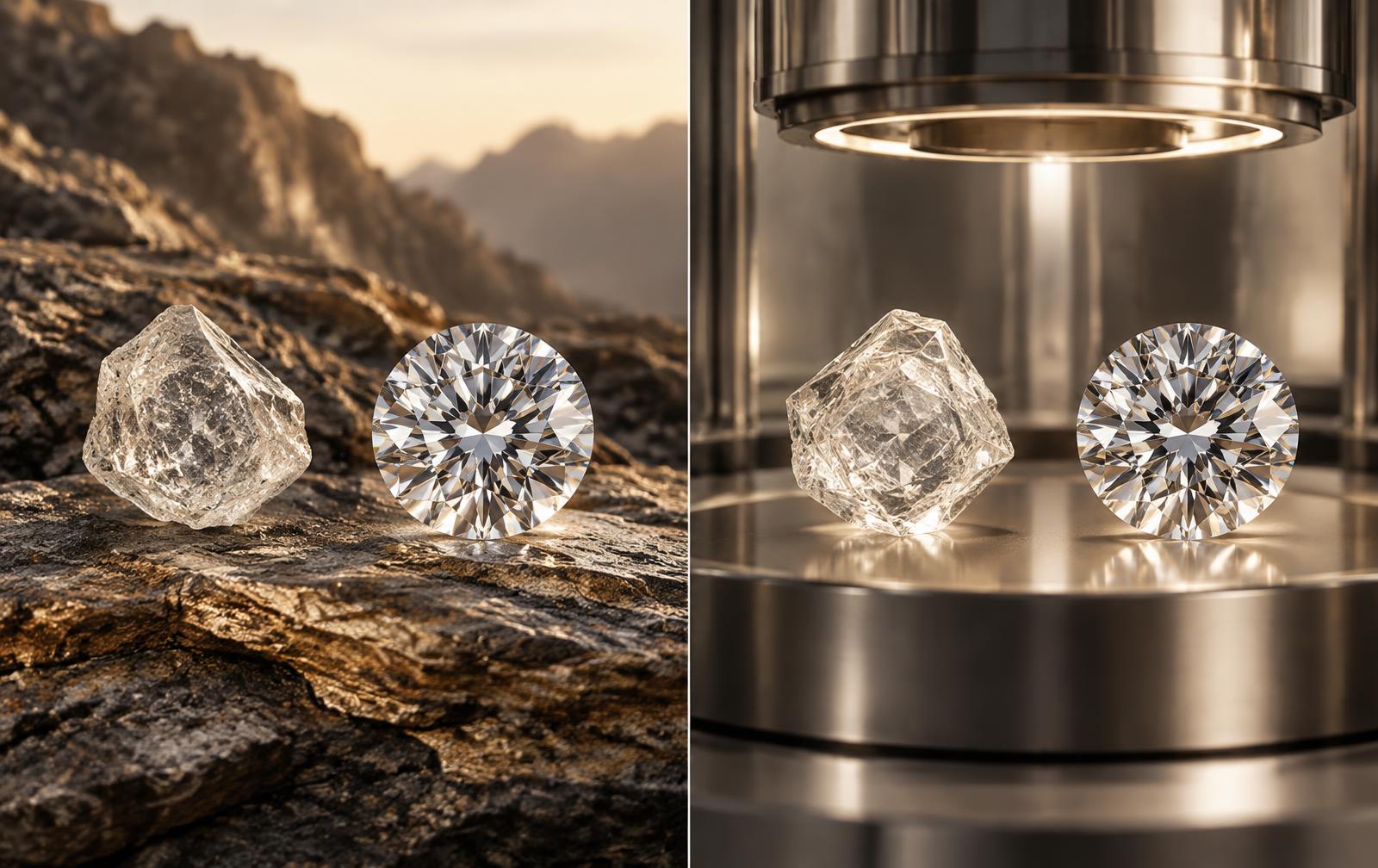
Geological formation
A natural diamond
Natural diamonds formed within the earth under conditions of heat and pressure over geological time, then traveled toward the surface through geological processes.
Controlled growth
A laboratory-grown diamond
Laboratory-grown diamonds are created in controlled environments using HPHT or CVD technology, producing diamond crystal that is later cut and polished.
02 · Comparison
What is the same. What is different.
Origin is the essential distinction. Both are diamond; clear identification and disclosure allow you to choose knowingly.
03 · Growth methods
HPHT and CVD, in brief.
Both methods begin with a diamond seed and controlled conditions. Their processes differ, and specialized testing can reveal growth features associated with origin and method.
HPHT
High Pressure High Temperature
- 01Diamond seed
- 02Metal solvent and carbon source
- 03High pressure and temperature support crystal growth
CVD
Chemical Vapor Deposition
- 01Diamond seed plate
- 02Carbon-containing gas in a low-pressure chamber
- 03Carbon deposits layer by layer as diamond crystal
04 · Identification
Can you tell by looking?
Not reliably by unaided visual inspection. Both can show brightness, fire, scintillation and inclusions. Specialized instrumentation and laboratory testing are used for definitive origin identification.
A report number may also be laser-inscribed on the girdle and verified with the issuing laboratory, but the inscription itself should be checked against the report.
05 · Grading & reports
Read the laboratory’s language.
Laboratories do not all use identical report formats or nomenclature. Review the issuing laboratory, service name, origin disclosure, measurements and quality information on the actual document.
Current GIA distinction
Since October 1, 2025, GIA’s Laboratory-Grown Diamond Quality Assessment for qualifying colorless-to-near-colorless laboratory-grown diamonds uses Premium or Standard classifications rather than presenting the service as the same traditional nomenclature used for natural diamonds.
IGI continues to offer laboratory-grown diamond reports with detailed 4Cs-style information. Always read the specific report; never assume every laboratory describes quality in the same way.
06 · How Nicotalya helps
Choose by what matters to you.
Neither origin is universally better. We present both clearly and guide around beauty, story, rarity preference, specifications and budget.
Natural may speak to you if…
- Geological origin and natural rarity are meaningful to you
- You prefer a diamond formed over geological time
- You want to compare individual natural diamonds within your priorities
Laboratory-grown may speak to you if…
- A controlled-growth origin aligns with your preference
- You want a different balance of size or specifications within a set budget
- You value clear origin disclosure and detailed comparison
Center and accent origins remain independent choices. A natural center may be paired with laboratory-grown accents, or the reverse, when the design supports the selected package.
Common questions
Questions, considered.
Are laboratory-grown diamonds real diamonds?
Yes. They are crystallized carbon with essentially the same optical and physical properties as natural diamonds; their origin is different.
Are they fake?
No. Diamond simulants such as cubic zirconia are different materials. Laboratory-grown diamonds are diamond and must be disclosed by origin.
Are they durable?
Both natural and laboratory-grown diamonds have the hardness associated with diamond. Durability of a finished ring also depends on setting, workmanship, wear and care.
Do they look different?
Not reliably to the unaided eye. Specialized testing is used to identify origin.
Can they contain inclusions?
Yes. Both origins can contain internal and surface characteristics.
How is origin disclosed?
Documentation and product descriptions should clearly identify laboratory-grown or laboratory-created origin. Reports may also state origin, and many stones carry a girdle inscription.
Can I choose a natural center and laboratory-grown accents?
Yes, where the setting offers that accent package. Center and accent origins are independent and disclosed separately.
Is one universally better?
No. The right choice depends on your priorities around origin, rarity, specifications, visual character and budget.
Compare diamonds with a specialist.
Personal guidance, at your pace.